

Perimeter Firewall Deployment
Secure Your Network Edge. End to End.
Hardware firewall design, supply, and configuration — from rule‑base design to HA failover testing. Enterprise NGFW with IPS, application control, and VPN.
Trusted by 30+ enterprises across India — securing their network perimeter






Why Enterprises Trust Layerix for
Perimeter Firewall Deployment
A firewall is only as good as the policy behind it. We design the rule base from scratch, test failover in real time, and document everything — all with zero subcontracting.

Vendor‑Neutral Design
We recommend the right platform for your environment — Fortinet, Check Point, Palo Alto, or Cisco — not the one with the best margin.
Policy‑Before‑Hardware
We design the security policy and rule base before any hardware is ordered, ensuring your firewall enforces exactly what your business needs.
HA & Failover Tested
Every high‑availability deployment is live‑tested — active‑passive failover verified and documented before handover.
DMZ Architecture
Public‑facing servers are isolated in a DMZ, preventing a compromised server from pivoting into your internal LAN.
100% In‑House Engineers
No subcontractors. Every firewall racked, cabled, and configured by a direct Layerix employee.
Full Documentation
You receive a documented rule base, topology diagrams, VPN config, admin credentials, and test results.
Firewall Deployment Process
Assessment
Review current posture, rule base, and requirements.
Policy Design
Document zone design, rules, and NAT before any hardware moves.
Procurement
Right-size the platform for throughput, HA, and feature requirements.
Physical Install
Rack, cable, and power — clean installation with labelled connections.
Configuration
Policy, routing, VPN, IPS, and application control applied to spec.
Testing & Failover
Rule-base validation, failover testing, and traffic verification.
Handover
Full documentation, admin credentials, and optional AMC enrolment.
Scope of Work
Firewall Architecture Types
Single Firewall
SMB / single-site / budget-conscious
Internet → Firewall → LAN
Single point of failure — suitable where budget is the primary constraint.
High Availability (Active-Passive)
Enterprises requiring uptime guarantee
Primary + Standby — automatic failover
Zero downtime on hardware failure. Recommended for all production environments.
DMZ Architecture
Organisations hosting public-facing servers
Internet → Firewall → DMZ (servers) + LAN (users)
A compromised server cannot pivot into your internal network.
Platform Selection Guide
| Platform | Best For | Strength |
|---|---|---|
| Fortinet FortiGate | SMB to large enterprise | Performance at price point |
| Check Point | Large enterprise | Deep policy management |
| Palo Alto Networks | High-security environments | App-ID & User-ID |
| Cisco ASA / Firepower | Cisco-centric environments | Integration depth |
| Sophos XGS | SMB / mid-market | Ease of management |
Layerix is vendor‑neutral. We recommend the right platform for your environment — not the one with the best margin.
Real Firewall Deployments
Every photo is from an actual Layerix deployment. No stock imagery. No subcontractors.
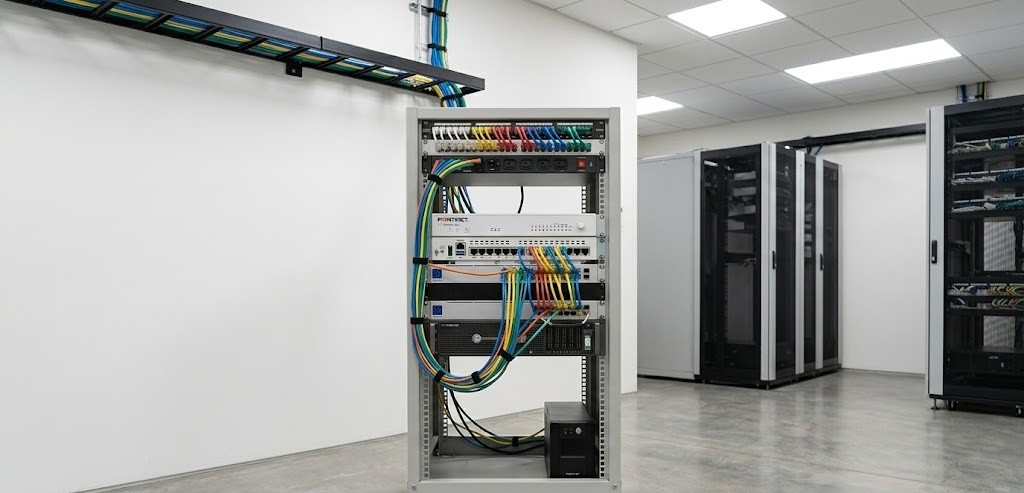
Firewall rack installation — corporate campus, Bengaluru
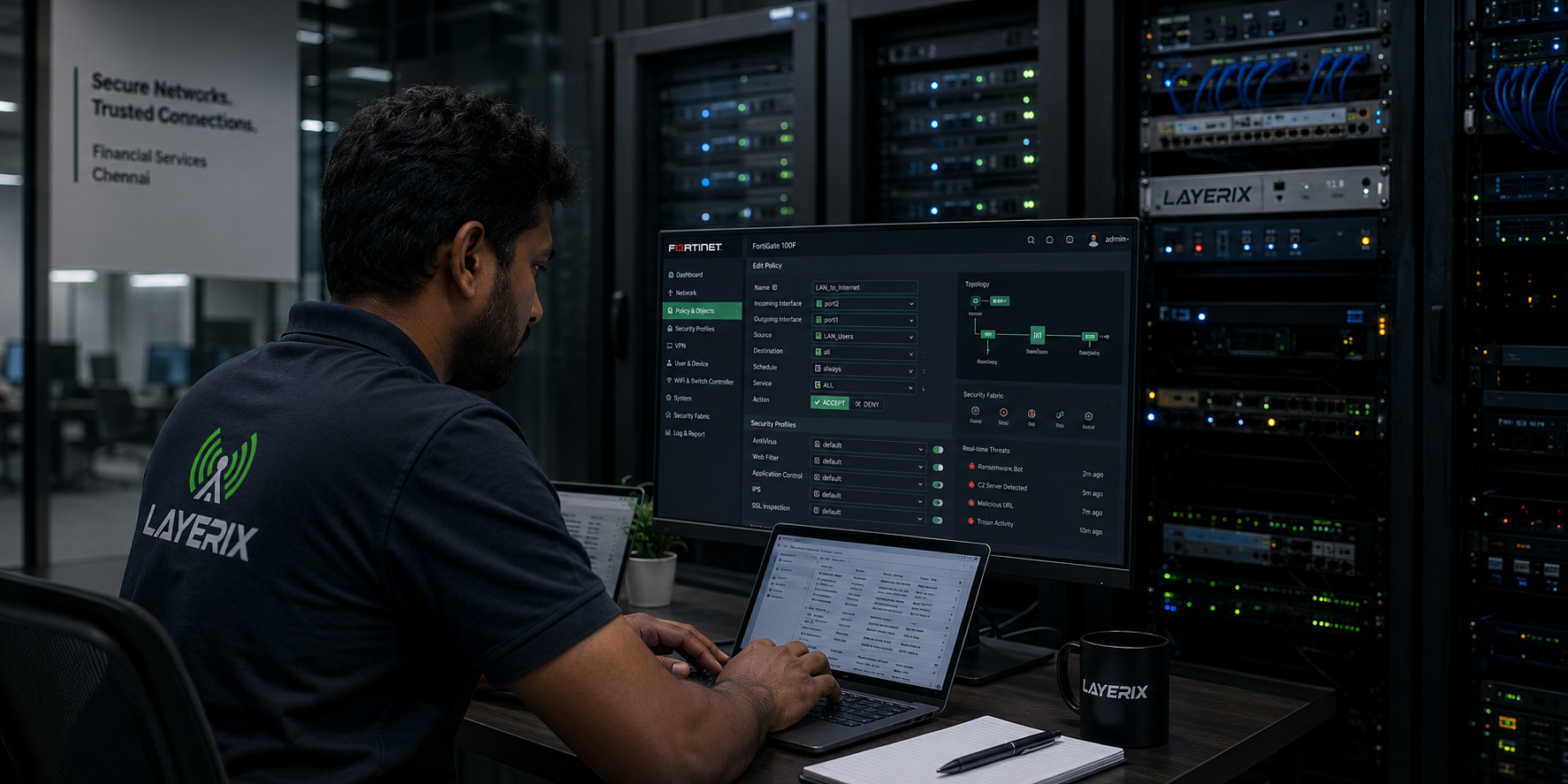
Policy configuration — financial services client, Chennai
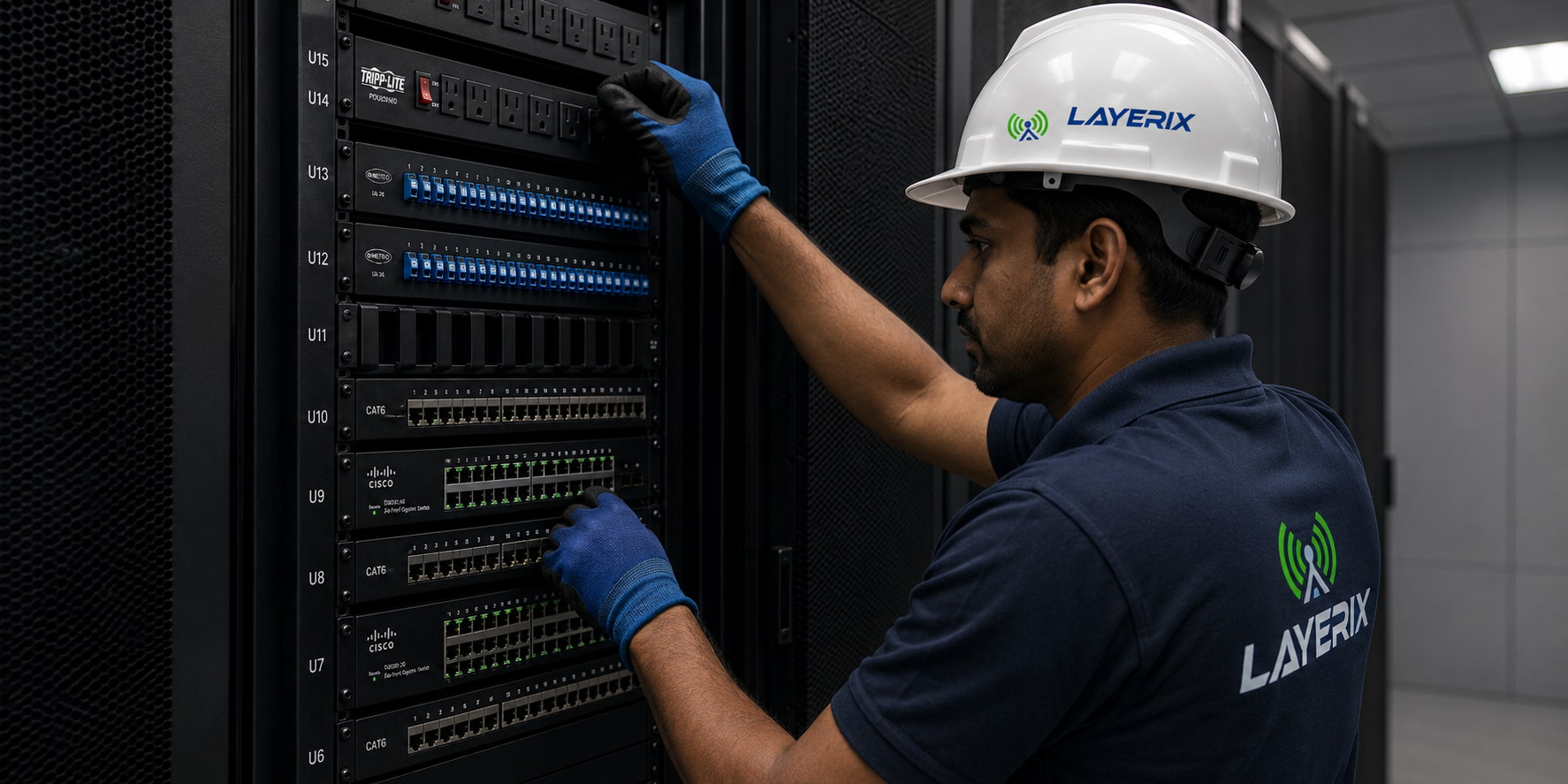
Post-install rack — pharmaceutical facility, Pune
25+ Firewall Deployments Across India
Enterprise firewalls in banking, pharma, logistics, and corporate environments — all 100% in‑house.
Firewall Solutions for Every Sector
Banking & Finance
PCI‑DSS, transaction security
Healthcare
Patient data protection
Pharmaceuticals
IP & regulatory compliance
Corporate Enterprises
Perimeter defence & VPN
Manufacturing
OT/IT segmentation
Technology
Code repository & cloud edge
Hospitality
Guest network isolation
Commercial Real Estate
Multi‑tenant security
Firewall Questions
Everything you need to know about perimeter firewall deployment.
How long does a firewall deployment take?+
A standard single-site deployment takes 1–2 days for a new installation. HA deployments or environments requiring complex policy migration take 3–5 days. We provide a detailed project timeline before starting.
Do you migrate our existing firewall rules to a new platform?+
Yes. We review your existing rule base, clean up redundant or conflicting rules, and migrate the valid policy to the new platform — with full documentation of every change made.
Can the firewall block specific applications, not just ports?+
Yes — next-generation firewalls perform deep packet inspection at the application layer. We configure application control policies to allow, block, or throttle specific applications regardless of the port they run on.
What is a DMZ and do we need one?+
A DMZ is a network segment that isolates public-facing servers from your internal LAN. If you host a web server, mail server, or any externally accessible application, a DMZ is strongly recommended to prevent a compromised server from becoming a gateway into your internal network.
What is high availability (HA) and do we need it?+
HA means two firewall appliances operate as a pair — if the primary fails, the secondary takes over automatically with no traffic interruption. We recommend HA for any environment where downtime is not acceptable.
Do you provide firewall-as-a-service or only on-premise hardware?+
Layerix specialises in on-premise hardware firewall deployment. For cloud or hybrid environments, we advise on the appropriate architecture and work with your cloud security controls.
What documentation do we receive after deployment?+
You receive the complete rule base in documented format, zone and topology diagrams, VPN configuration details, admin credentials, and test results. Nothing leaves our engineers undocumented.
Can you manage the firewall after installation under an AMC?+
Yes — Layerix AMC covers firmware updates, policy changes, annual rule-base reviews, and incident response. You can also manage it yourself; we train your team during handover.
What is the difference between IPS and a firewall?+
A firewall controls which traffic is allowed based on rules (IP, port, application). An IPS (Intrusion Prevention System) inspects the content of allowed traffic for malicious patterns and blocks attacks in real time. Modern NGFWs include both — and we configure both during deployment.
Will a new firewall slow down our internet speed?+
When correctly sized, no. Throughput degradation occurs when a firewall is under-spec'd for the volume of traffic or the number of active features (UTM, IPS, SSL inspection). We size every platform for your actual throughput requirement with headroom.
Do you work with internet service providers during deployment?+
Yes. We coordinate with your ISP for WAN handoff, BGP configuration (where applicable), and failover link setup. We manage the full edge deployment — you do not need to manage the ISP side separately.
Our Firewall Success Stories
Real outcomes from enterprises across India






















METEC Design and Construction Engineers India Private Limited
India




















Ready to Secure Your Network Edge?
Book a firewall assessment. Our certified engineer audits your current perimeter and delivers a documented security policy — no obligation.
Response within 4 business hours · Pan‑India deployments · Fortinet, Check Point, Palo Alto certified