
Instant AP, Cloud-Managed, or Controller-Based Wi-Fi? Wrong Choice Costs Lakhs.
Somewhere in Bengaluru right now, an IT admin is standing on a chair, USB Wi-Fi adapter plugged into a laptop, trying to figure out why the "excellent coverage" the vendor promised turns into a dead zone the exact moment you walk past the pantry.
Sound familiar? That's not bad luck. That's what happens when the Wi-Fi architecture decision got made in five minutes during a budget meeting, by someone who's never had to actually support it at 6 PM on a Friday.
Instant AP, cloud-managed, or controller-based — three genuinely different ways to run enterprise Wi-Fi, and the "wrong" one doesn't just annoy your users. It quietly costs lakhs, one over-provisioned AP, one truck-roll, one Sunday-night escalation at a time. Let's actually go through it properly.
First, What Are We Even Choosing Between?
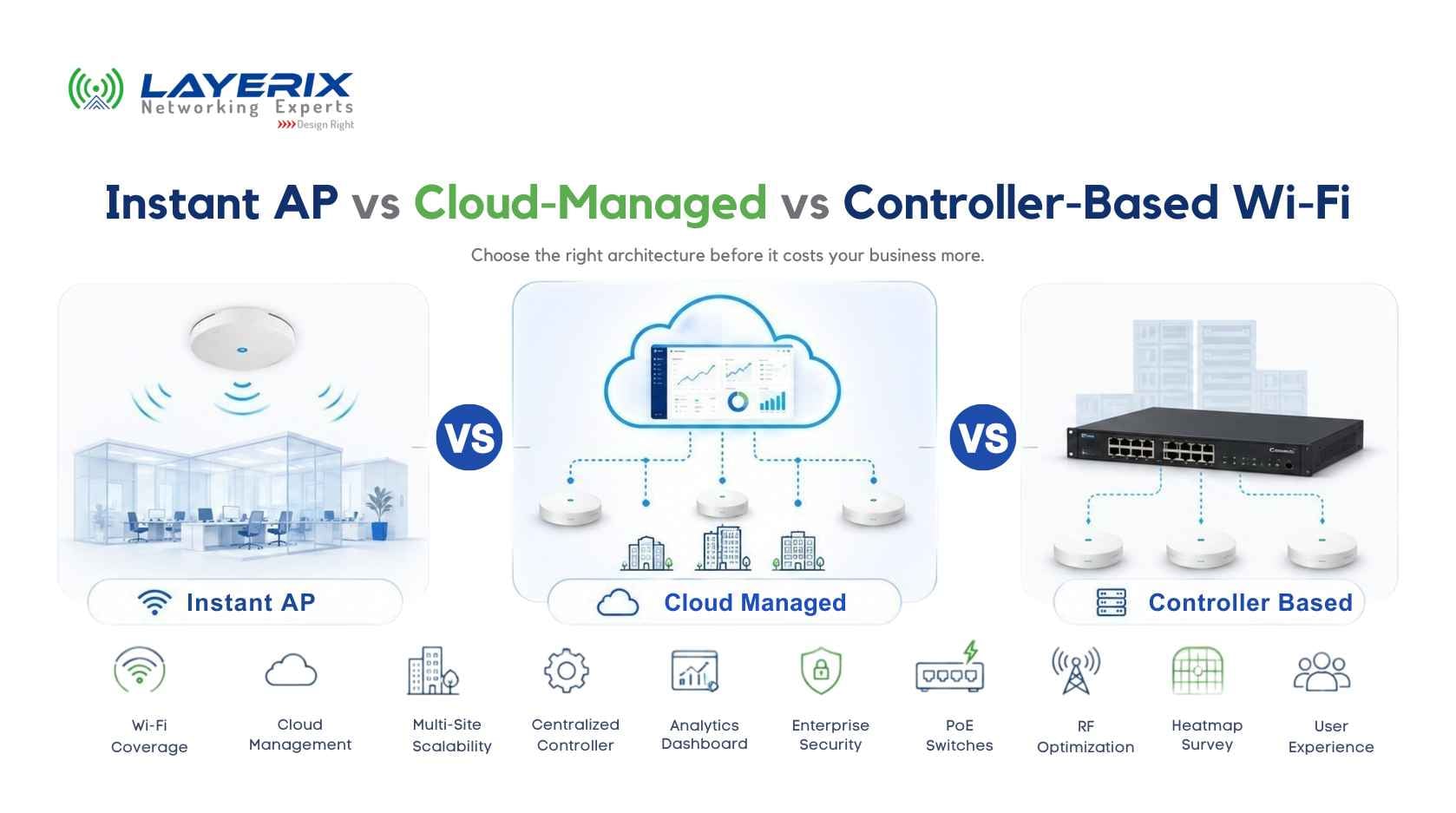
Instant AP / Standalone
Each access point runs independently, with little or no centralized brain. Fine for a five-room office. A genuine liability the moment you cross a few floors — because now every AP is its own little island, and nobody's coordinating channels, roaming, or firmware between them.
Controller-Based
A physical (or virtual) controller on your premises manages every AP centrally — SSIDs, roaming policy, RF optimization, all from one on-site box. Powerful, but that box is now a single point of failure sitting in your server room.
Cloud-Managed
Moves the brain to the cloud. One dashboard, every AP, every site, real-time alerts, zero-touch provisioning. No controller sitting in a rack waiting to fail. The direction most new enterprise deployments in India are headed.
The War Stories Every IT Admin Recognizes
"The 52-AP Quote That Should've Been 34"
A 3-floor corporate office in Bengaluru got a vendor quote for 52 access points. Before signing, they ran a proper Wi-Fi heatmap survey — predictive RF planning that actually models your floor plan instead of guessing.
Correct AP count: 34
That "guesswork tax" would've cost ₹4.2 lakh in unnecessary hardware alone.
"The Switch That Couldn't Feed Its Own APs"
New Wi-Fi 6 access points go in, everything looks great on day one, and then three weeks later, ports start browning out under load — because the PoE switch powering them was never sized for the actual wattage draw.
This is exactly why PoE switch sizing isn't optional homework — a 10-AP deployment at 25W each needs roughly 300W of PoE budget with headroom.
"The Controller That Became a Ghost Town"
An IT admin inherits a controller-based Wi-Fi setup from three years ago. The person who configured it left. The controller firmware hasn't been touched since. And now every troubleshooting session starts with "does anyone actually know the admin password?"
This is the quiet cost of controller-based Wi-Fi with no succession plan — a single physical box holding your entire network hostage to institutional memory.
"The 50-Store Road Trip Nobody Signed Up For"
A retail chain running standalone APs across 50 locations in Karnataka and Maharashtra had one option when something broke: send someone. Physically. To the store.
After moving to cloud-managed Wi-Fi, field visits dropped by 80% and rollout time for new stores dropped 60% thanks to zero-touch provisioning.
"The AP Bolted On Without Anyone Checking If It'd Even Talk to the Rest"
Someone in facilities buys a cheap AP off Amazon to fix a dead zone in the warehouse. It doesn't support the existing SSID architecture, doesn't join the same VLAN, and now IT has two separate Wi-Fi networks that don't know about each other.
Correct access point deployment — survey-first, vendor-compatible, centrally configured — exists precisely to prevent this exact kind of well-intentioned chaos.
So Which One Actually Saves You Money?
Here's the honest breakdown, because "it depends" needs a number attached to be useful:
| Factor | Instant AP | Controller-Based | Cloud-Managed |
|---|---|---|---|
| Upfront Cost | Low | Medium (controller hardware) | Medium (licensing) |
| Recurring Cost | Low | Low | Medium (subscription) |
| Hidden Cost | Your time (scales with AP count) | Controller maintenance, succession risk | Negligible |
| Multi-Site Scaling | ❌ Painful | ⚠️ VPN tunnels required | ✅ Effortless |
| Single Point of Failure | ⚠️ Each AP independent | ❌ Controller is SPOF | ✅ Cloud HA |
| Best For | <10 APs, single floor | Single campus, dedicated IT | Multi-site, lean teams |
The pattern across every war story is the same: the expensive mistake was never the architecture itself. It was skipping the survey, skipping the power budget, or picking based on lowest upfront quote instead of actual total cost of ownership.
Three Questions Before You Sign Anything
How many sites will this Wi-Fi network actually need to cover — today, and in 18 months?
Single-site favors controller-based or even standalone. Multi-site strongly favors cloud.
Has anyone actually modeled your floor plan, or is the AP count a guess based on square footage?
If it's the latter, you're one RF site survey India away from finding out you're about to overpay.
Who's physically responsible for this network when the person who set it up leaves the company?
If the honest answer is "nobody, really" — cloud-managed's centralized documentation and dashboard access solves a problem you don't know you have yet.
Quick Decision Guide: Which Architecture Fits Your Business?
Small office, <10 APs, single floor
Use Instant AP / Standalone. Simple, low cost, no controller needed.
Single large campus, 50+ APs, dedicated IT staff
Use Controller-Based. Deep RF control, centralised policy enforcement.
Multi-site enterprise, 10+ locations, lean IT team
Use Cloud-Managed with zero-touch AP provisioning.
High-density wireless environment (stadiums, convention centres)
Start with a predictive/active survey, then choose controller or cloud based on scale.
The Bottom Line
There's no universally "right" architecture — a five-room branch office genuinely doesn't need Cisco Meraki, and a 500-AP campus genuinely shouldn't run on standalone APs held together with hope.
What actually costs lakhs isn't picking controller-based over cloud, or cloud over standalone — it's picking any of them without a proper RF site survey, a proper PoE switch sizing, and a proper plan for who maintains it in year two.
Start with a heatmap, size the power correctly, and pick the management model that matches how many sites you're actually running — not how many the vendor hopes you'll eventually need. Get that sequence right, and "Wi-Fi problems" stops being a recurring line item in every IT department meeting in this city.
Not Sure Which Wi-Fi Architecture Fits Your Business?
Layerix's certified wireless engineers will assess your site, model your floor plan, and recommend the right deployment model before a single AP is purchased.
R Swaminathan
Founder & CTO, Layerix Networking Experts. 24+ years in enterprise networking. JNCIE-SP certified. Former Network Architect for Facebook, Google, AWS, AT&T, and leading Indian banks.
Ready to optimize your network?
Contact Layerix Networks for expert IT infrastructure and networking solutions.